
Blogs
How to get more out of every advertising euro: the role of AI in marketing
The rise of AI has fundamentally changed the way companies do marketing. What, ten years ago, was reserved exclusively for large corporations with expensive data teams is now accessible to any SME with an average marketing budget.

Blogs
How to get more out of every advertising euro: the role of AI in marketing
The rise of AI has fundamentally changed the way companies do marketing. What, ten years ago, was reserved exclusively for large corporations with expensive data teams is now accessible to any SME with an average marketing budget.
AI adoption in marketing accelerates decision-making, increases targeting accuracy, and improves return on ad spend. The combination of AI technology and human expertise consistently delivers better results than either alone. That is precisely what Aizy is built on.
What is AI in marketing?
AI in marketing is the use of self-learning algorithms, language-understanding technology, and predictive analysis to automate, analyze, and optimize marketing tasks. AI software independently recognizes patterns in customer data, adjusts ad performance in real-time, and optimizes campaigns based on behavioral data without manual intervention per optimization.
Artificial intelligence strengthens marketing strategy; it does not replace it. AI technology processes data at a speed and scale that is manually impossible. The marketer determines the course, sets goals, and interprets context. AI and human expertise together deliver better results than either individually.
AI in marketing operates on 3 separate layers:
Automation: adjusting bids, sending triggered emails, and generating reports
Analysis: turning large datasets into actionable insights about target groups, trends, and campaign performance
Personalization: showing each customer the most relevant message on the right channel at the right time

Why use AI in marketing?
Companies using AI for marketing achieve demonstrably better campaign results with the same budget. Below are the 5 most direct benefits, specifically for SMEs looking to get the maximum return from every advertising dollar.
1. Higher ROI on marketing campaigns
AI automatically identifies the most profitable keywords, target groups, and bidding times. Ad waste decreases because the system continuously learns from performance data. The direct result is a higher return on investment (ROI) on digital advertising campaigns.
Eleganza, a fashion eCommerce client of Aizy, achieved 42% revenue growth in Q4 2025 with only 3% extra ad spend. More return from the same budget: that is what AI-driven optimization combined with human strategic insight delivers.
2. Faster data-driven decisions
AI analyzes datasets in seconds. Patterns that would otherwise only become visible after weeks of manual analysis are immediately available in the marketing dashboard. Data-driven decision-making replaces decisions based on assumptions. Marketers make informed decisions faster and with more certainty about the expected result.
3. More accurate targeting and personalization
Traditional audience segmentation works on broad demographic categories. AI segmentation works on actual behavior, purchase intent, and individual preferences of each user. Personalized ads that align with the recipient's current situation consistently perform better than generic campaigns and measurably increase conversion rates.
4. Time savings through marketing automation
AI takes over repetitive tasks: adjusting bids, sending triggered emails, generating reports, and adjusting budget distributions. Marketers consequently have measurably more time left for strategy, creativity, and direct customer contact.
5. Deeper insights from customer data
AI discovers connections in customer and consumer data that remain invisible to manual analysis. What combination of factors predicts customer churn? Which segments convert on which type of message? Which ad attracts the most valuable visitor? These insights form the foundation for campaign strategies that consistently perform better. Companies utilizing these insights guide by data instead of assumptions.
AI applications in digital marketing
AI in marketing is deployed in 8 defined areas within the digital marketing funnel. Below are the most impactful applications in campaign management, advertising, search engine optimization, and content development.
AI in digital advertising and programmatic
Google Ads Smart Bidding and Meta Advantage+ adjust bids based on 6 types of signals: time of day, device, location, search intent, user behavior, and conversion probability, in real-time and per auction. Programmatic advertising goes a step further: AI automatically purchases ad space the moment the right user is available, at the most efficient price per impression.
AI for marketing automation and workflows
Marketing automation automates marketing processes based on triggers and behavioral rules. AI makes this automation more precise: AI does not just send a pre-set email sequence, but adjusts timing, subject, and content based on the behavior of the individual recipient. AI-driven lead nurturing is more personalized and delivers higher conversion rates without extra manual work.
Predictive analysis and lead scoring
AI predicts which leads have the highest probability of converting based on 3 data sources: behavioral data, demographic data, and historical campaign performance. Sales teams focus their attention on the most promising prospects. Marketing teams allocate budgets based on where conversion is statistically most likely. Predictive analytics makes marketing proactive instead of reactive.
Audience segmentation and personalization at scale
AI segments customer groups automatically and in real-time based on behavior, purchase intent, and life stage. Every website visitor, newsletter reader, and ad clicker receives an experience that aligns with that specific user's current situation. Automated personalization at scale increases customer engagement, extends session duration, and consistently improves conversion rates.
AI tools for ad management and bidding strategy
Specialized AI tools for ad management manage bidding strategies across platforms: budgets shift automatically between Google, Meta, and other channels based on real-time performance. Campaign structures automatically adapt to seasonal patterns and market changes without manual intervention.
AI tools for content development
Generative AI tools such as ChatGPT and similar AI content tools accelerate content development: ad copy, social media posts, product descriptions, and visual content. Generative AI tools reduce the production time of creative material by an average of 40 to 60%. Human editing remains necessary for quality control: AI generates, the marketer reviews and refines.
AI tools for data analysis and reporting
Analytics platforms with built-in AI functionality, including Google Analytics 4, automatically detect anomalies, signal trend breaks, and generate clear reports. Manual data extraction that used to take 60 to 90 minutes is now immediately available for interpretation and decision-making.
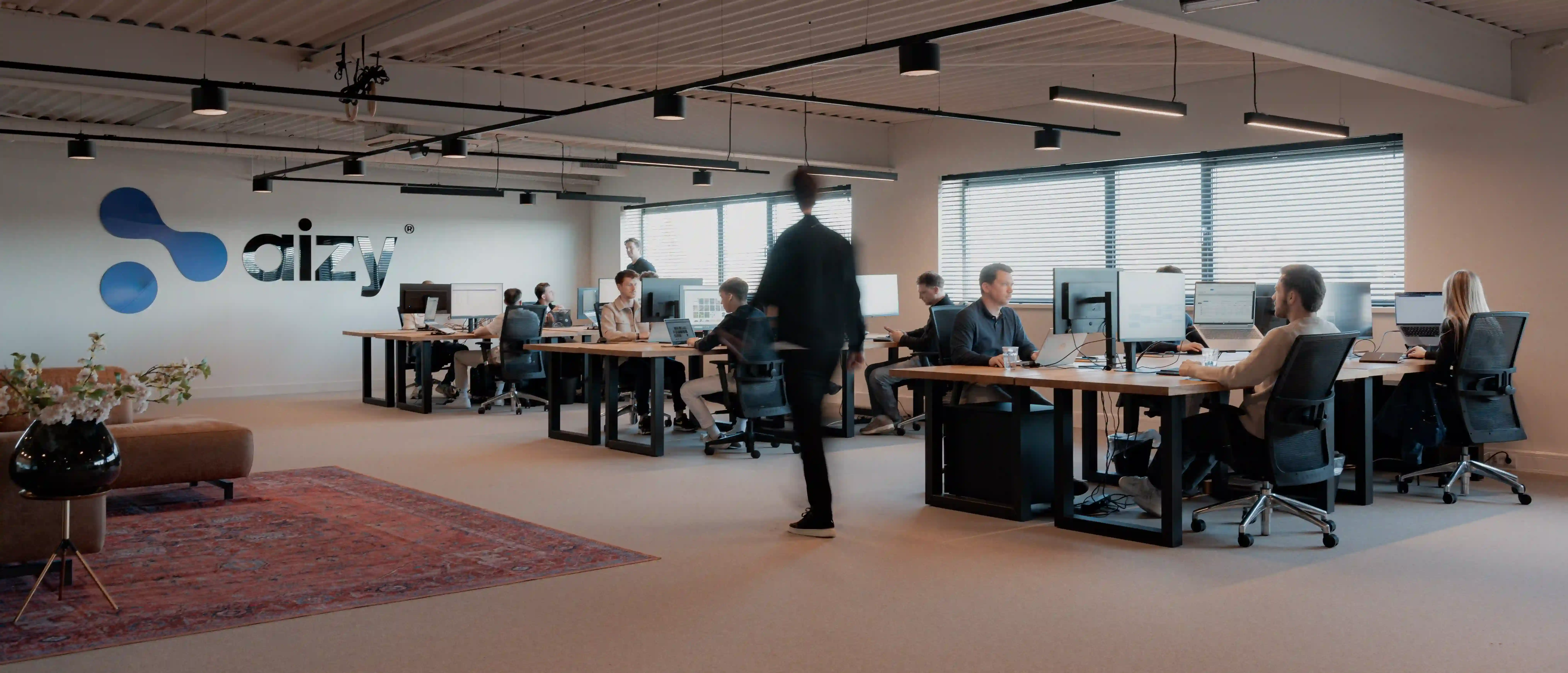
How to implement AI in your marketing strategy
For SMEs, starting with AI marketing is easier than it seems. It begins with a concrete objective, not with a tool. Below are the 5 sequential steps Aizy applies in every new collaboration.
1. Determine your marketing goals Concrete, measurable objectives are at the beginning of every successful AI implementation. Whether generating more leads, increasing ROAS, or lowering acquisition costs: the objective determines which AI marketing tools you need. Selecting tools without pre-established goals leads to fragmented deployment without measurable results.
2. Analyze your data and current performance An audit of available customer data, campaign history, and website statistics lays the foundation. AI produces the best results with clean, structured, and up-to-date data as input. A clear baseline measurement makes the impact of AI implementation later demonstrable in concrete figures.
3. Select the right AI tools AI marketing tools that align with the team's objectives, budget, and knowledge level perform better than complex all-in-one solutions. Start with tools that solve a single, concrete problem, such as Smart Bidding in Google Ads or automated email sequences. Unnecessary complexity is the most common pitfall in AI implementations within SMEs.
4. Start with a pilot Test AI marketing first on a single channel or campaign. The results of a controlled pilot provide insight into the actual impact, including the system's learning curve in the first 4 to 8 weeks.
5. Measure, adjust, and scale up AI systems improve based on new data, but human monitoring of KPIs remains essential. Measurement as a regular cycle forms the basis for structural growth: checking results weekly and adjusting where the AI output deviates from the set goals. AI optimizes execution. The marketer optimizes strategy.
Best practices for AI-driven marketing
Combine AI with human expertise
A recurring question: does AI replace the marketer? No. AI takes over repetitive and data-intensive tasks. Strategic thinking, creativity, and customer relationship management remain human tasks. AI and human expertise are complementary, not interchangeable. Companies that run AI autonomously without human supervision miss strategic nuance. Companies that do not deploy AI lose efficiency and competitive advantage. The best campaign results come from the systematic combination of both. That is the core of the Aizy approach.
Start small and scale step-by-step
Start with one application, such as Smart Bidding in Google Ads, and prove its value in measurable KPIs. Step-by-step scaling to a second and third channel prevents team overload and keeps output quality high.
Invest in high-quality data
The quality of AI output is directly dependent on the quality of the input. Clean, structured customer data delivers more accurate segmentation, better predictions, and more effective personalization. Data hygiene is the technical foundation of any AI marketing strategy.
Keep testing and adjusting
AI marketing is evolving rapidly. Tools and algorithms that are the standard today will be surpassed by newer developments within 12 to 24 months. Systematic testing of new applications and adjusting based on measured results is the most effective approach to growing AI-driven marketing.
The future of AI and marketing
Generative AI for marketing and sales
The future of AI in marketing revolves largely around generative AI. The availability of tools like ChatGPT and Google Gemini has made generative AI widely accessible. The role of generative AI in content development, campaign management, and automated customer interaction grows year over year. Sales teams deploy generative AI for personalized outreach at scale. Marketing teams use it for automated content development that is manually unfeasible.
Hyper-personalization at scale
The trend in AI marketing is shifting from segment-based campaigns to actual individualization. AI delivers a unique, relevant message to each customer at the right moment and on the right channel. Hyper-personalization at scale deepens customer relationships, increases loyalty, and consistently improves conversion rates.
The changing role of the marketer
The marketer is shifting from an executor of manual tasks to the strategist behind AI systems. The marketer defines goals, monitors the quality of AI output, and translates data into business strategy. AI takes over execution. The marketer determines the direction.
How AI and human expertise work together in marketing
The best marketing results come from the systematic combination of AI and human expertise, not from choosing one over the other. AI processes data, optimizes campaigns, and personalizes at scale. The marketer delivers strategy, creativity, and contextual understanding that no algorithm can match.
Aizy's approach is built on this principle. Aizy's AI technology runs campaigns, analyzes data, and applies optimizations automatically. Aizy's senior performance specialists monitor strategy, brainstorm growth opportunities with clients, and ensure that AI output aligns with concrete business goals.
This way, as an entrepreneur, you are always in control of your own results, with full visibility into where every advertising dollar is going. Technology without people is blind. People without technology are slow. AI and human expertise together are unbeatable.
Better results from AI-driven marketing with Aizy
Aizy combines AI-driven marketing with the expertise of senior performance specialists, specifically for SMEs looking to get the maximum return from Google Ads, Meta, and SEO. Built-in AI features in Google Ads and Meta are included in the advertising budget. Specialized AI marketing tools cost an average of €100 to €500 extra per month. Collaborating with Aizy is more cost-effective for SMEs than implementing and managing tools themselves, and consistently yields higher returns.
Aizy clients achieve an average of +36% more conversions in the first 90 days of partnership. Not through a larger budget, but through systematic AI optimization combined with human strategic insight.
AI adoption in marketing accelerates decision-making, increases targeting accuracy, and improves return on ad spend. The combination of AI technology and human expertise consistently delivers better results than either alone. That is precisely what Aizy is built on.
What is AI in marketing?
AI in marketing is the use of self-learning algorithms, language-understanding technology, and predictive analysis to automate, analyze, and optimize marketing tasks. AI software independently recognizes patterns in customer data, adjusts ad performance in real-time, and optimizes campaigns based on behavioral data without manual intervention per optimization.
Artificial intelligence strengthens marketing strategy; it does not replace it. AI technology processes data at a speed and scale that is manually impossible. The marketer determines the course, sets goals, and interprets context. AI and human expertise together deliver better results than either individually.
AI in marketing operates on 3 separate layers:
Automation: adjusting bids, sending triggered emails, and generating reports
Analysis: turning large datasets into actionable insights about target groups, trends, and campaign performance
Personalization: showing each customer the most relevant message on the right channel at the right time
Why use AI in marketing?
Companies using AI for marketing achieve demonstrably better campaign results with the same budget. Below are the 5 most direct benefits, specifically for SMEs looking to get the maximum return from every advertising dollar.
1. Higher ROI on marketing campaigns
AI automatically identifies the most profitable keywords, target groups, and bidding times. Ad waste decreases because the system continuously learns from performance data. The direct result is a higher return on investment (ROI) on digital advertising campaigns.
Eleganza, a fashion eCommerce client of Aizy, achieved 42% revenue growth in Q4 2025 with only 3% extra ad spend. More return from the same budget: that is what AI-driven optimization combined with human strategic insight delivers.
2. Faster data-driven decisions
AI analyzes datasets in seconds. Patterns that would otherwise only become visible after weeks of manual analysis are immediately available in the marketing dashboard. Data-driven decision-making replaces decisions based on assumptions. Marketers make informed decisions faster and with more certainty about the expected result.
3. More accurate targeting and personalization
Traditional audience segmentation works on broad demographic categories. AI segmentation works on actual behavior, purchase intent, and individual preferences of each user. Personalized ads that align with the recipient's current situation consistently perform better than generic campaigns and measurably increase conversion rates.
4. Time savings through marketing automation
AI takes over repetitive tasks: adjusting bids, sending triggered emails, generating reports, and adjusting budget distributions. Marketers consequently have measurably more time left for strategy, creativity, and direct customer contact.
5. Deeper insights from customer data
AI discovers connections in customer and consumer data that remain invisible to manual analysis. What combination of factors predicts customer churn? Which segments convert on which type of message? Which ad attracts the most valuable visitor? These insights form the foundation for campaign strategies that consistently perform better. Companies utilizing these insights guide by data instead of assumptions.
AI applications in digital marketing
AI in marketing is deployed in 8 defined areas within the digital marketing funnel. Below are the most impactful applications in campaign management, advertising, search engine optimization, and content development.
AI in digital advertising and programmatic
Google Ads Smart Bidding and Meta Advantage+ adjust bids based on 6 types of signals: time of day, device, location, search intent, user behavior, and conversion probability, in real-time and per auction. Programmatic advertising goes a step further: AI automatically purchases ad space the moment the right user is available, at the most efficient price per impression.
AI for marketing automation and workflows
Marketing automation automates marketing processes based on triggers and behavioral rules. AI makes this automation more precise: AI does not just send a pre-set email sequence, but adjusts timing, subject, and content based on the behavior of the individual recipient. AI-driven lead nurturing is more personalized and delivers higher conversion rates without extra manual work.
Predictive analysis and lead scoring
AI predicts which leads have the highest probability of converting based on 3 data sources: behavioral data, demographic data, and historical campaign performance. Sales teams focus their attention on the most promising prospects. Marketing teams allocate budgets based on where conversion is statistically most likely. Predictive analytics makes marketing proactive instead of reactive.
Audience segmentation and personalization at scale
AI segments customer groups automatically and in real-time based on behavior, purchase intent, and life stage. Every website visitor, newsletter reader, and ad clicker receives an experience that aligns with that specific user's current situation. Automated personalization at scale increases customer engagement, extends session duration, and consistently improves conversion rates.
AI tools for ad management and bidding strategy
Specialized AI tools for ad management manage bidding strategies across platforms: budgets shift automatically between Google, Meta, and other channels based on real-time performance. Campaign structures automatically adapt to seasonal patterns and market changes without manual intervention.
AI tools for content development
Generative AI tools such as ChatGPT and similar AI content tools accelerate content development: ad copy, social media posts, product descriptions, and visual content. Generative AI tools reduce the production time of creative material by an average of 40 to 60%. Human editing remains necessary for quality control: AI generates, the marketer reviews and refines.
AI tools for data analysis and reporting
Analytics platforms with built-in AI functionality, including Google Analytics 4, automatically detect anomalies, signal trend breaks, and generate clear reports. Manual data extraction that used to take 60 to 90 minutes is now immediately available for interpretation and decision-making.
How to implement AI in your marketing strategy
For SMEs, starting with AI marketing is easier than it seems. It begins with a concrete objective, not with a tool. Below are the 5 sequential steps Aizy applies in every new collaboration.
1. Determine your marketing goals Concrete, measurable objectives are at the beginning of every successful AI implementation. Whether generating more leads, increasing ROAS, or lowering acquisition costs: the objective determines which AI marketing tools you need. Selecting tools without pre-established goals leads to fragmented deployment without measurable results.
2. Analyze your data and current performance An audit of available customer data, campaign history, and website statistics lays the foundation. AI produces the best results with clean, structured, and up-to-date data as input. A clear baseline measurement makes the impact of AI implementation later demonstrable in concrete figures.
3. Select the right AI tools AI marketing tools that align with the team's objectives, budget, and knowledge level perform better than complex all-in-one solutions. Start with tools that solve a single, concrete problem, such as Smart Bidding in Google Ads or automated email sequences. Unnecessary complexity is the most common pitfall in AI implementations within SMEs.
4. Start with a pilot Test AI marketing first on a single channel or campaign. The results of a controlled pilot provide insight into the actual impact, including the system's learning curve in the first 4 to 8 weeks.
5. Measure, adjust, and scale up AI systems improve based on new data, but human monitoring of KPIs remains essential. Measurement as a regular cycle forms the basis for structural growth: checking results weekly and adjusting where the AI output deviates from the set goals. AI optimizes execution. The marketer optimizes strategy.
Best practices for AI-driven marketing
Combine AI with human expertise
A recurring question: does AI replace the marketer? No. AI takes over repetitive and data-intensive tasks. Strategic thinking, creativity, and customer relationship management remain human tasks. AI and human expertise are complementary, not interchangeable. Companies that run AI autonomously without human supervision miss strategic nuance. Companies that do not deploy AI lose efficiency and competitive advantage. The best campaign results come from the systematic combination of both. That is the core of the Aizy approach.
Start small and scale step-by-step
Start with one application, such as Smart Bidding in Google Ads, and prove its value in measurable KPIs. Step-by-step scaling to a second and third channel prevents team overload and keeps output quality high.
Invest in high-quality data
The quality of AI output is directly dependent on the quality of the input. Clean, structured customer data delivers more accurate segmentation, better predictions, and more effective personalization. Data hygiene is the technical foundation of any AI marketing strategy.
Keep testing and adjusting
AI marketing is evolving rapidly. Tools and algorithms that are the standard today will be surpassed by newer developments within 12 to 24 months. Systematic testing of new applications and adjusting based on measured results is the most effective approach to growing AI-driven marketing.
The future of AI and marketing
Generative AI for marketing and sales
The future of AI in marketing revolves largely around generative AI. The availability of tools like ChatGPT and Google Gemini has made generative AI widely accessible. The role of generative AI in content development, campaign management, and automated customer interaction grows year over year. Sales teams deploy generative AI for personalized outreach at scale. Marketing teams use it for automated content development that is manually unfeasible.
Hyper-personalization at scale
The trend in AI marketing is shifting from segment-based campaigns to actual individualization. AI delivers a unique, relevant message to each customer at the right moment and on the right channel. Hyper-personalization at scale deepens customer relationships, increases loyalty, and consistently improves conversion rates.
The changing role of the marketer
The marketer is shifting from an executor of manual tasks to the strategist behind AI systems. The marketer defines goals, monitors the quality of AI output, and translates data into business strategy. AI takes over execution. The marketer determines the direction.
How AI and human expertise work together in marketing
The best marketing results come from the systematic combination of AI and human expertise, not from choosing one over the other. AI processes data, optimizes campaigns, and personalizes at scale. The marketer delivers strategy, creativity, and contextual understanding that no algorithm can match.
Aizy's approach is built on this principle. Aizy's AI technology runs campaigns, analyzes data, and applies optimizations automatically. Aizy's senior performance specialists monitor strategy, brainstorm growth opportunities with clients, and ensure that AI output aligns with concrete business goals.
This way, as an entrepreneur, you are always in control of your own results, with full visibility into where every advertising dollar is going. Technology without people is blind. People without technology are slow. AI and human expertise together are unbeatable.
Better results from AI-driven marketing with Aizy
Aizy combines AI-driven marketing with the expertise of senior performance specialists, specifically for SMEs looking to get the maximum return from Google Ads, Meta, and SEO. Built-in AI features in Google Ads and Meta are included in the advertising budget. Specialized AI marketing tools cost an average of €100 to €500 extra per month. Collaborating with Aizy is more cost-effective for SMEs than implementing and managing tools themselves, and consistently yields higher returns.
Aizy clients achieve an average of +36% more conversions in the first 90 days of partnership. Not through a larger budget, but through systematic AI optimization combined with human strategic insight.
Free demo
Discover right away where your growth lies.
In a short demo, you'll discover where your greatest growth opportunities lie.
140,000
AI optimizations / month
-37%
Advertising costs
+32%
ROAS
+200%
Organic traffic

Free demo
Discover right away where your growth lies.
In a short demo, you'll discover where your greatest growth opportunities lie.
140,000
AI optimizations / month
-37%
Advertising costs
+32%
ROAS
Free demo
Discover right away where your growth lies.
In a short demo, you'll discover where your greatest growth opportunities lie.
140,000
AI optimizations / month
-37%
Advertising costs
+32%
ROAS
+200%
Organic traffic
RECOMMENDED ARTICLES
Other insights

Blogs
Grotere bestellingen, stabiel rendement: 4 Google Ads-trends bij onze webshops in 2026
Grotere bestellingen, stabiel rendement: 4 Google Ads-trends bij onze webshops in 2026

Jouw checklist met Black Friday voorbereiding
Jouw checklist met Black Friday voorbereiding

Blogs
Black Friday 2026: het seizoen begint in week 44, niet in week 48
Black Friday 2026: het seizoen begint in week 44, niet in week 48

Blogs
Black Friday 2026: vergeet SEO niet in je voorbereiding
Black Friday 2026: vergeet SEO niet in je voorbereiding

Blogs
Een productfeed, vier kanalen: waarom je titels je grootste ongebruikte hefboom zijn
Een productfeed, vier kanalen: waarom je titels je grootste ongebruikte hefboom zijn

Blogs
Waar zijn de Google organische product carrousels gebleven?
Waar zijn de Google organische product carrousels gebleven?

Blogs
Hoeveel aanvragen je kwijtraakt op je eigen aanvraagformulier
Hoeveel aanvragen je kwijtraakt op je eigen aanvraagformulier

Blogs
Content written by AI. What is the impact on your rankings?
Content written by AI. What is the impact on your rankings?

Blogs
How you measure marketing growth in the AI era
How you measure marketing growth in the AI era

See how findable you are in Google and AI
See how findable you are in Google and AI
RECOMMENDED ARTICLES
Other insights
Blogs
Grotere bestellingen, stabiel rendement: 4 Google Ads-trends bij onze webshops in 2026
Grotere bestellingen, stabiel rendement: 4 Google Ads-trends bij onze webshops in 2026
Jouw checklist met Black Friday voorbereiding
Jouw checklist met Black Friday voorbereiding
Blogs
Black Friday 2026: het seizoen begint in week 44, niet in week 48
Black Friday 2026: het seizoen begint in week 44, niet in week 48
Blogs
Black Friday 2026: vergeet SEO niet in je voorbereiding
Black Friday 2026: vergeet SEO niet in je voorbereiding
Blogs
Een productfeed, vier kanalen: waarom je titels je grootste ongebruikte hefboom zijn
Een productfeed, vier kanalen: waarom je titels je grootste ongebruikte hefboom zijn
Blogs
Waar zijn de Google organische product carrousels gebleven?
Waar zijn de Google organische product carrousels gebleven?
Blogs
Hoeveel aanvragen je kwijtraakt op je eigen aanvraagformulier
Hoeveel aanvragen je kwijtraakt op je eigen aanvraagformulier
Blogs
Content written by AI. What is the impact on your rankings?
Content written by AI. What is the impact on your rankings?
Blogs
How you measure marketing growth in the AI era
How you measure marketing growth in the AI era
See how findable you are in Google and AI
See how findable you are in Google and AI